Your First 30 Days in Sri Lanka: Bank Account, SIM, Driving Permit and Healthcare
Team LiveInLanka · July 29, 2026 · 11 min read · Practical Guides
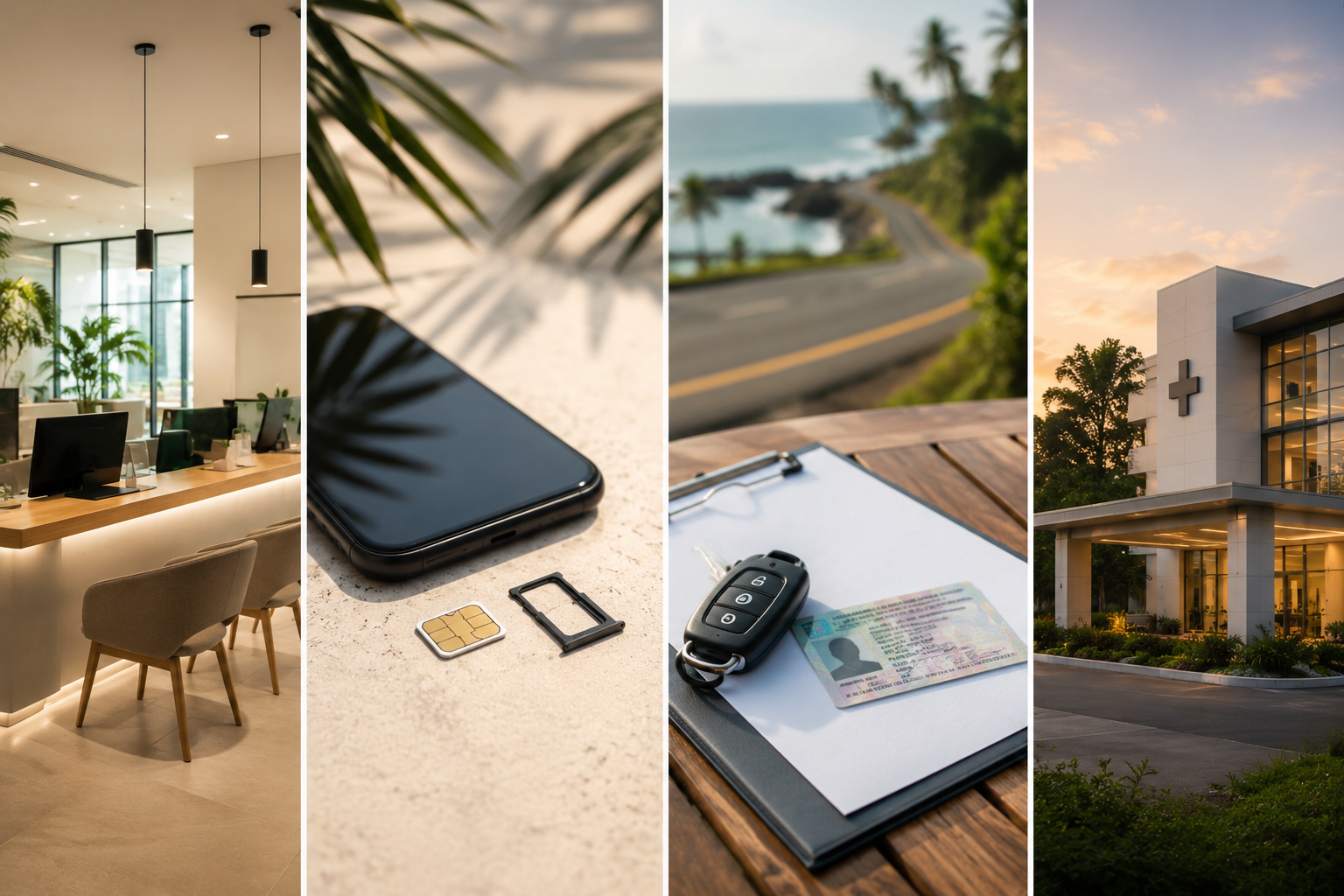
Most relocation guides stop at “get the visa and book your flight”. The real work – and most of the frustration – happens in your first 30 days on the ground.
This article is a practical, chronological checklist of what to do in your first month in Sri Lanka: SIM, money and banking, driving, and healthcare. It is written for long‑stay visitors and new residents who actually want to live here, not just pass through.
Day 1–3: Land, connect, and get your basics sorted
If you are arriving with family, a lot of luggage, or straight off a long-haul flight, a fast-tracked arrival is worth considering. We coordinate VIP airport arrival — meet and greet, fast-track immigration and customs, porter assistance and lounge access — through our trusted partner Royal Aviation Lanka, a CAASL-approved ground handling company operating 24/7 at Colombo (CMB), Mattala and Ratmalana.
1. Get your local SIM at the airport
At Bandaranaike International Airport (BIA), you will see official telecom counters (Mobitel, Dialog and others) just after arrivals. For most long-stays, a physical SIM or eSIM package with generous data is the fastest way to:
- Have local data immediately for ride‑hailing and maps.
- Start testing mobile coverage in the area where you will actually live.
What to bring:
- Passport.
- Local address if you already have accommodation booked (hotel address is fine initially).
You can change your package or move to a different provider later if needed.
2. Sort cash, cards, and a backup money plan
Sri Lanka is still partially cash-based, especially outside major supermarkets and malls. In your first days:
- Withdraw some LKR cash from ATMs at the airport or in town using your foreign card.
- Keep a second card stored separately as a backup.
- Test contactless payments in bigger supermarkets and petrol stations – availability is improving but not universal.
If you plan to receive income while in Sri Lanka, talk to your home bank and consider multi‑currency apps that can hold LKR or at least send to Sri Lankan accounts cheaply.
Week 1–2: Driving and local mobility
3. Decide whether you actually need to drive
The south and hill country look small on the map, but driving here can be intense: narrow roads, buses, tuk‑tuks, animals, and changing weather.
Before jumping into paperwork, ask:
- Can you rely on tuk‑tuks, taxis, and drivers for your daily routine?
- Do you need a scooter or car for school runs, surf spots, or remote workspaces?
If you do need to drive, you must be legal. A home-country licence alone is not enough.
4. Get your temporary driving permit
Foreigners need either:
- A temporary Sri Lankan driving licence/permit, or
- A permit based on their International Driving Permit (IDP), depending on the scheme currently in force.
The easiest route for many long‑stayers is to obtain a temporary permit at BIA or through the Automobile Association of Ceylon or Department of Motor Traffic.
Typical requirements:
- Passport and valid visa.
- Original home-country driving licence.
- Sometimes an International Driving Permit (IDP).
- Passport-sized photos (can often be taken on site).
The temporary licence can be issued for several months (up to around five months) at a time, after which you may need to renew or move to a different solution if you stay longer.
If this feels overwhelming, this is precisely the kind of admin LiveInLanka handles during the settlement phase – helping you choose whether you should even drive yourself, and if so, arranging the right permits.
Renting a scooter or car once you are legal
Most South Coast rentals are still arranged in cash on arrival, which is awkward when you have just landed and have no local currency. Our trusted partner Viungo Tours is the first South Coast operator to offer instant online prebooking with secure card payment, so the vehicle is reserved and waiting for you.
- Indicative daily rates start around USD 7 for an automatic scooter, USD 12 for a 125cc, and USD 25–60 for cars.
- Helmets, phone mounts and delivery to your accommodation are included.
- They also advise on the recognition permit you need to ride or drive legally on a foreign licence.
Renting vs buying
Rent first. Almost nobody should buy a vehicle in their first month, before they know which town they will settle in or how much they will actually drive.
If you do decide to own one later, the rules changed recently: Sri Lanka lifted its vehicle import ban in February 2025, and passenger cars within three years of manufacture can now be imported. Our partner Vinvel Motor Trading has been importing auction-graded cars from Japan since 2010, with verified auction sheets and all-in pricing that includes duty, taxes and shipping. Japanese auctions also list European and American models, so you are not limited to Japanese brands.
Week 1–3: Banking and money in practice
5. Understand what kind of bank account you can open
Sri Lanka’s banking rules and practical behaviour can differ from branch to branch. In general:
- As a short‑term visitor, you may have access mainly to foreign currency accounts rather than full local current accounts.
- Some banks expect you to have a longer‑term visa or proof of residence before opening certain types of accounts.
Most long‑stayers solve this by:
- Continuing to use home-country accounts and cards.
- Using multi‑currency wallets for daily spending.
- Opening a Personal Foreign Currency Account (PFCA) when they meet the criteria and genuinely need to receive inward remittances locally.
6. What to prepare for a potential bank visit
If, after a few weeks, you decide you need a local account, expect to be asked for some or all of:
- Passport.
- Valid visa and sometimes proof of intended stay (e.g. visa category or residence permit).
- Local address (rental agreement or hotel letter).
- Proof of income or source of funds.
- The bank’s own application and KYC forms.
Pick branches that are known to work with foreigners. Colombo and some regional centres are typically more experienced than very small-town branches.
Week 2–4: Healthcare and peace of mind
7. Map your healthcare options before you need them
Sri Lanka has a mix of public and private healthcare. For most expats and long-stayers, private hospitals and clinics are the practical choice, especially in Colombo and larger cities.
In your first month, you should:
- Identify the nearest reputable private hospital or clinic to your new home (e.g. Asiri, Nawaloka, Lanka Hospitals in Colombo; selected private facilities in Galle and Kandy).
- Note emergency numbers and outpatient clinic hours.
- Check whether your international health insurance covers Sri Lanka and whether the hospital can bill your insurer directly or expects you to pay first and claim later.
8. Do a low-stress “test visit”
Instead of waiting for an emergency, many new residents book a basic:
- GP check‑in,
- or routine blood test,
- or simple consultation.
This low-pressure visit helps you:
- Understand wait times and payment processes.
- See how comfortable you feel with the staff and environment.
If you are retiring or have chronic conditions, this step is especially important.
Throughout the first 30 days: Admin that trips people up
9. Address registration and proof of residence
Even if nobody asks in week one, at some point you will need proof of address:
- Visa extensions and certain long‑stay paths.
- Local services and some bank products.
- School registrations if you have children.
Make sure your lease, guesthouse booking, or homestay arrangement can be documented on paper or email with dates, names, and contact details.
10. Internet at home
For remote workers, this is as important as water and electricity. In your first month:
- Check what connection is already installed (fiber vs 4G router vs basic ADSL).
- Run speed tests at the hours you actually work.
- Ask the landlord whether power backups (UPS) exist for the router, and if not, consider installing one.
In some towns, mobile data as a backup can save your day when a line goes down or there is a power cut.
11. Local transport routines
Once initial jet lag fades, you will quickly see whether your life is:
- Walkable,
- Tuk‑tuk based,
- or dependent on a scooter/car.
Use the first 30 days to experiment. Many long‑stayers realise they do not need to drive as much as they thought once they have:
- A favourite tuk‑tuk driver,
- A small circle of places they visit regularly,
- and remote work routines that do not require daily long commutes.
Putting it all together
Your first month in Sri Lanka sets the tone for the rest of your stay. If you:
- Connect quickly (SIM and money basics),
- Stay legal and safe on the road (permits and realistic driving choices),
- Understand your banking options instead of fighting them, and
- Map your healthcare before you need it,
you reduce 80% of the friction most people feel when they first move.
If you would prefer to have someone walk you through this step by step – and, where possible, handle the coordination for you – this entire 30‑day checklist is built into LiveInLanka’s settlement and concierge tiers. remitly