Weligama vs Ahangama vs Mirissa vs Hiriketiya: Where Should You Actually Live on the South Coast?
Team LiveInLanka · July 29, 2026 · 9 min read · Relocation & Lifestyle
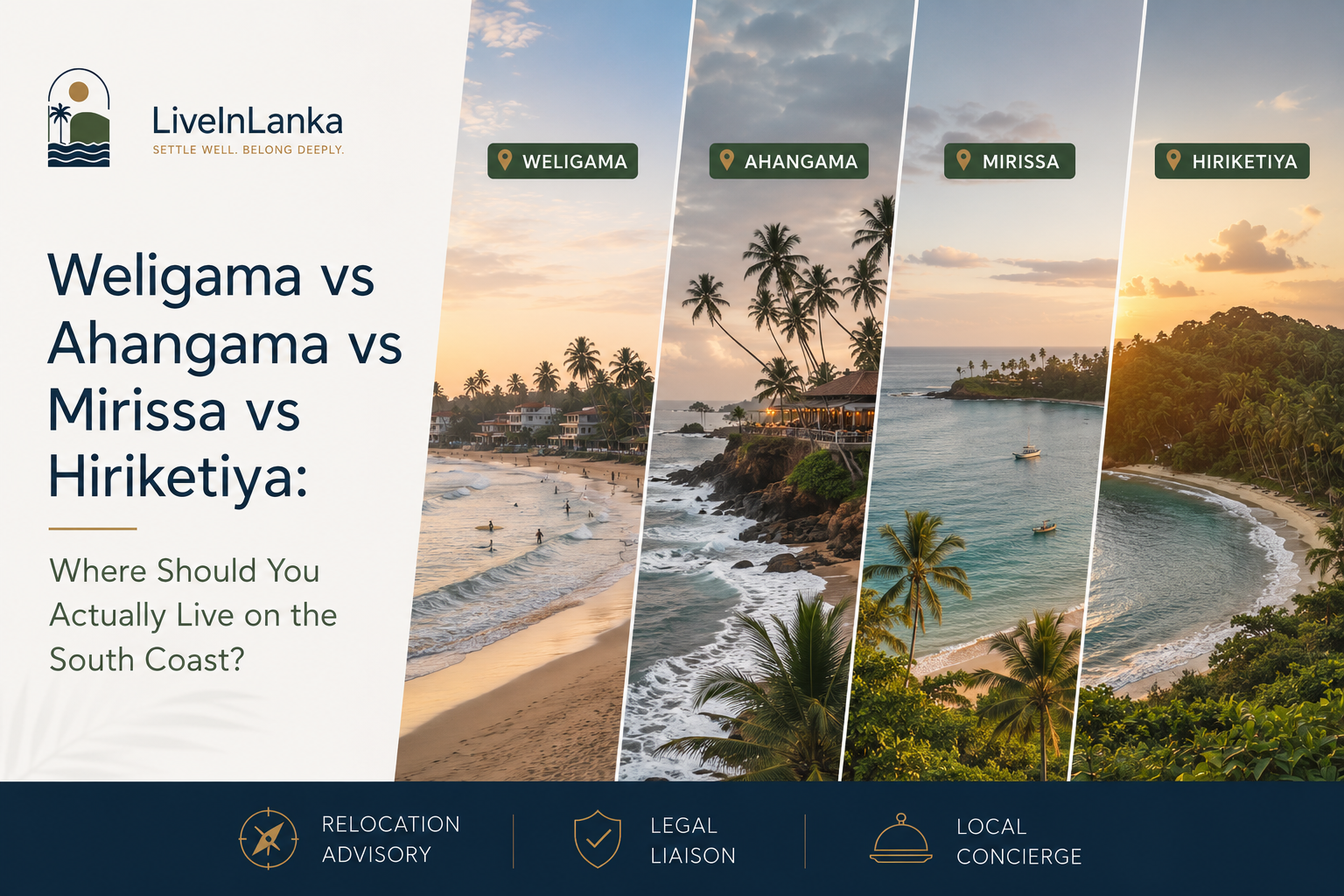
Most articles about Sri Lanka’s south coast are written for short-term travelers: where to find the best smoothie bowl this week, which hostel has the biggest party, or where to surf for a few days. If you are planning to actually live here for three months or more, you need a very different kind of guide.
One of our own clients, Sophie from France, arrived certain she wanted Weligama. Once we went through her routine, noise tolerance, and work style, she ended up in Ahangama instead – and after a few months, she was very glad she changed her mind.
This article is written from a residency point of view: who each town suits, who it does not, and what starts to annoy people after month three.
How to use this guide
Each town breakdown covers:
- Vibe and who it suits.
- Who it does not suit.
- Surf vs quiet.
- Cafés and work spots.
- Internet reality.
- Very rough long-stay rents (for basic, non-luxury places).
- What tends to annoy people over time.
At the end of each section you will see a link to a pre-filled cost of living calculator so you can plug in your own numbers based on that town.
Weligama: Busy, convenient, and not as cheap as it looks
Weligama is usually the first name people hear when they search for “digital nomads in Sri Lanka”. There is a reason: surfable waves almost every day of the season, a large concentration of hostels and guesthouses, and plenty of Western-friendly cafés that understand what a laptop is.
Who it suits:
- First-timers who want to be around other foreigners and a visible nomad scene.
- People who value convenience over peace and quiet.
- Surfers who want a forgiving beach break right in front of town.
Who it does not suit:
- Light sleepers.
- People who hate traffic noise and construction.
- Anyone dreaming of a quiet village feel.
Surf vs quiet:
- Beach break in town, easy for beginners, lessons everywhere.
- Quiet spots exist, but you often need to live a little bit out of the main bay.
Cafés and work density:
- Good density of cafés that are used to people working on laptops.
- A few co-working style spaces and coliving setups.
Internet reality:
- Fiber connections exist in many guesthouses and apartments, but quality varies by street and building. Backups (mobile data + small UPS) are still a good idea.
Rough long-term rent:
- Expect basic studios and small one-bed apartments to start around the lower mid-range of south coast prices; anything modern, with AC and good internet, tends to climb quickly due to high demand.
What annoys people after month three:
- Traffic noise and horns on the main road.
- Construction noise as new hotels and villas get built.
- Feeling like you live in a transient backpacker hub instead of a community.
Run your numbers for Weligama:
- Try the calculator preloaded for Weligama: `/cost-of-living?town=weligama`.
Ahangama: Surf town with a calmer, creative edge
Ahangama sits just down the coast from Weligama, and in many ways feels like its slightly older, more relaxed cousin. There is surf, but also more space between places, more low-key restaurants, and a growing creative community.
Who it suits:
- People who still want surf and cafés but don’t want Weligama’s intensity.
- Remote workers who want a quieter base but easy access to nearby hotspots.
- Couples and solo travelers who value community over nightlife.
Who it does not suit:
- People who hate walking or tuk-tuking; things are more spread out.
- Those who want a big nightlife scene at their doorstep.
Surf vs quiet:
- Several reef and point breaks dotted along the coastline.
- More options to live on quieter side roads or inland lanes away from the highway.
Cafés and work density:
- Fewer spots than Weligama, but still enough laptop-friendly cafés.
- Many long-stayers end up splitting their week between home, a favourite café, and occasional trips to Weligama for variety.
Internet reality:
- Similar to Weligama: fiber is available in many places, but you still need to confirm line quality per property and have mobile data as backup.
Rough long-term rent:
- You can still find more value than in Weligama for comparable quality if you are willing to be a bit off the main road or a few minutes inland.
What annoys people after month three:
- The spread-out layout can feel inconvenient without your own scooter or driver.
- During peak season, certain stretches become busy with traffic between surf spots.
Run your numbers for Ahangama:
- Try the calculator preloaded for Ahangama: `/cost-of-living?town=ahangama`.
Mirissa: Pretty, Instagrammable, and not really a long-stay base
Mirissa is famous in travel blogs for its picture-perfect beach, coconut tree hill, and whale watching. It is beautiful – but beauty does not automatically make it a good place to live.
Who it suits:
- Shorter stays.
- People who like being around holiday energy and don’t mind crowd cycles.
Who it does not suit:
- Long-term remote workers who need routine and calm.
- People who want to feel part of a neighbourhood rather than a resort strip.
Surf vs quiet:
- Mirissa has surf options, but the beach is more about swimming and photos.
- Truly quiet living often means staying on the fringes or slightly outside Mirissa.
Cafés and work density:
- Plenty of cafés and restaurants on the main strip.
- Far fewer genuinely work-friendly spaces compared with Weligama.
Internet reality:
- Wi‑Fi in hotels and guesthouses is usually fine for casual use, but for daily remote work many people end up commuting to Weligama or Ahangama.
Rough long-term rent:
- You can find off-season deals, but in season Mirissa’s beachfront and near-beach options are often priced with tourists in mind, not long-stay residents.
What annoys people after month three:
- Feeling trapped in a tourist bubble.
- Crowds, loud music, and rotating neighbours.
Run your numbers for Mirissa:
- Try the calculator preloaded for Mirissa: `/cost-of-living?town=mirissa`.
Hiriketiya: Small, social bay living
Hiriketiya is a compact horseshoe bay that has become extremely popular with surfers and digital nomads. It has a strong sense of place: you quickly recognise faces, and the whole bay is walkable.
Who it suits:
- People who want a small, social community feel.
- Long-stayers who like walking more than riding and enjoy seeing familiar faces.
- Beginners and intermediate surfers.
Who it does not suit:
- Anyone who needs lots of anonymity or big-city options.
- People who dislike the idea that “everyone knows everyone”.
Surf vs quiet:
- Very consistent beginner-friendly wave in the bay.
- The area just around the bay can feel crowded in peak months.
Cafés and work density:
- Several cafés where laptops are normal.
- A few coliving spots built specifically with remote workers in mind.
Internet reality:
- For such a small place, Hiriketiya is surprisingly workable for remote work when you pick the right accommodation – but testing the exact line and having backup data is non‑negotiable.
Rough long-term rent:
- Because it is small and in high demand, per-square-metre prices can be higher than in less-famous nearby towns, especially for walkable-to-the-bay properties.
What annoys people after month three:
- The bay’s small size can start to feel limiting.
- High season crowding, especially when surf schools are busy.
Run your numbers for Hiriketiya:
- Try the calculator preloaded for Hiriketiya: `/cost-of-living?town=hiriketiya`.
Getting around once you are there
Whichever town you pick, mobility shapes daily life on the south coast more than people expect. Ahangama and Mirissa in particular are spread out enough that walking everywhere becomes tiring after a few weeks.
- Tuk-tuks and ride-hailing work well for short hops and are cheap, but availability thins out late at night and in quieter villages.
- A scooter is what most long-stayers end up with. It turns a 25-minute walk into a five-minute ride and makes comparing towns genuinely easy.
- A car starts to make sense with children, frequent Galle or Colombo runs, or during monsoon months.
For rentals we work with Viungo Tours, who deliver serviced and insured scooters, motorbikes and cars across the south coast and can be booked and paid for online before you arrive. They also run private guided day trips — whale watching from Mirissa, Yala and Udawalawe safari, Galle Fort and tea country — which are a useful way to scout the wider area during a trial stay.
If you eventually want your own car rather than a rental, our partner Vinvel Motor Trading imports auction-graded vehicles from Japan with duty, taxes and shipping included in the quoted price. Wait until you have chosen a town before committing to that, though — what you need in Mirissa is not what you need in Ahangama.
So, where should you actually live?
A very rough rule of thumb:
- Choose Weligama if you want maximum convenience, don’t mind noise, and like being in the obvious hub.
- Choose Ahangama if you want surf and cafés but a calmer base and don’t mind being a few minutes further from everything.
- Choose Mirissa for shorter stays or if you truly value a picture-perfect beach over everyday logistics.
- Choose Hiriketiya if you want a small bay community and are okay with higher demand and a tighter bubble.
If you’re still unsure, the best next step is a structured Discovery & Plan call where we map your daily routine against these towns and build a personalised plan instead of guessing from Instagram. redwhiteadventures