The Open-Door Life: Why Families Are Trading the Nordic Grind for Sri Lanka
Team LiveInLanka · October 3, 2026 · 8 min read · Culture & Community
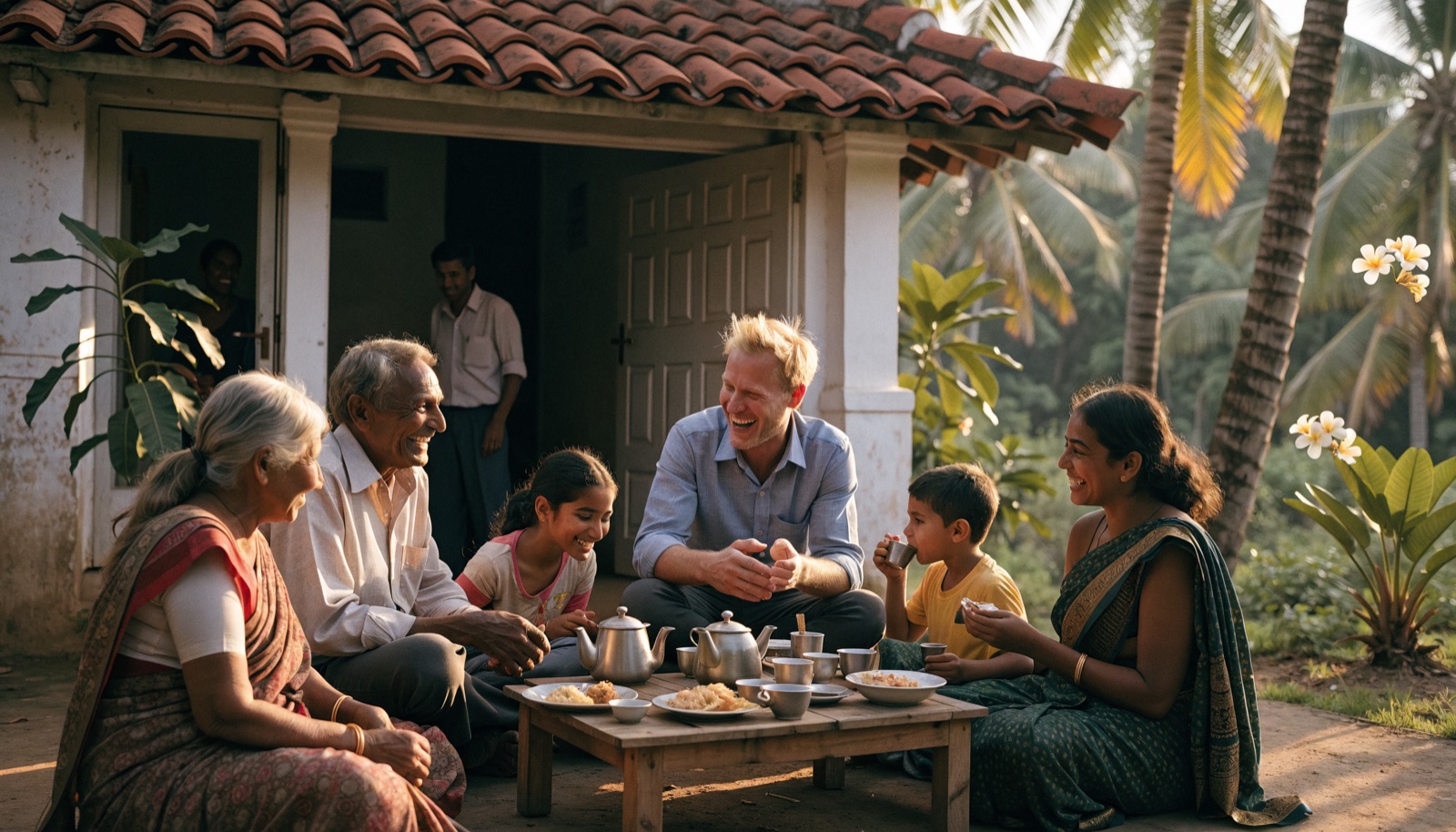
A while back, a man from Scandinavia posted a simple question on the Sri Lanka subreddit. He was 30, had been happily married to his Sri Lankan wife for over ten years, and every time they visited her family near Hikkaduwa he felt more certain that this was where he wanted to live.
He asked the practical stuff: what's a livable wage, how do people feel about foreigners, how much should we save first.
What he got back was a flood. Dozens of replies. Some warm, some blunt, a few telling him he'd lost his mind. Why would anyone leave a country with great healthcare, safe roads and good salaries for a place that just came through an economic crisis?
His answer to that question is the reason we're writing this post. Because it's the same answer we hear, in different accents, from almost every family who contacts us.
"Our front door is locked from the moment we get home"
Here's roughly how he put it. He'd lived his whole life across three Nordic countries. Salaries are good. Healthcare is excellent. Roads are safe. He wasn't complaining about any of that.
What was missing was harder to name: family, fun, friends dropping by.
He described a life where your front door closes when you get home and doesn't open again until you leave for work the next morning. Where seeing friends or relatives is something you schedule weeks in advance. Where a family Christmas party has to be locked in three to five months ahead, and calling your siblings to say "come over tonight" simply doesn't work, because everyone needs a month's notice.
"Everything is going down to micromanaging your life," he wrote. "It's not a joyful life, it's a life full of stress."
A Sri Lankan commenter replied, almost puzzled: "Really, three to five months ahead? Here they come to our home whenever they want and stay as long as they want. It's your family after all."
That little exchange says more about the pull of Sri Lanka than any brochure ever could.
The open-door life is real
If you've spent time in a Sri Lankan home, you know what we mean. Doors stay open through the day. Neighbours wander in with a bag of rambutan from their tree. An aunt turns up unannounced, and somehow there's rice and curry for six instead of four. Nobody apologises for the mess, because nobody's counting.
Kids grow up surrounded by adults who aren't their parents but who look out for them anyway: the grandmother next door, the tuk-tuk driver who takes them to school every morning, the man at the corner shop who knows exactly which biscuits they like.
One commenter, born and raised in Sri Lanka and by their own description not from a comfortable family, put it beautifully. Of everything the country offers, the thing that's genuinely irreplaceable is community. "A helping hand can be found here at any time."
Another, who'd moved back after years in the West and the Middle East, struggled to put it into words and finally landed on this: "Sri Lanka has a heart."
We don't think that's sentimental. We think it's a fair description of a society that still runs on relationships first and schedules second.
"Grass is green where you water it"
The most-quoted line from that whole thread came from a Sri Lankan living in Sweden, someone with a foot in both worlds.
He pointed out that plenty of people telling the original poster not to come were themselves looking at the West through the classic "grass is greener" lens. Then he said the line that stuck: "Grass is green where you water it."
He'd been in Sri Lanka during the economic crisis. Fuel queues, power cuts, all of it. Was it annoying? Of course. "But that's life," he wrote. "I would much rather spend time with loved ones and lead a good life than live a life just to work." And then, plainly: "We are not born to just work and die."
He also did the maths most people skip. A two- or three-bedroom house in Sweden can easily cost the equivalent of 120 million rupees, with thirty years of mortgage payments attached. The original poster agreed: his own home had cost around 110 million rupees, sat an hour from the capital, and still had 27 years left on the loan.
When you frame it like that, the question changes. It stops being "can I afford to move to Sri Lanka?" and becomes "what am I actually buying with the life I have now?"
The criticism is real too, and that's fine
We'd be doing you a disservice if we pretended everyone in that thread was cheering. They weren't.
Some Sri Lankans told him flatly not to come. They talked about corruption, bureaucracy, low local wages, the effort it takes to renew a licence or open a bank account. One man who'd moved to Australia said he misses home every winter (the flip-flops, the evening beer by the sea) but wouldn't move back for good, and warned against mistaking "the awe of a vacation for a desire to move back."
That's an honest perspective and it deserves respect. Here's the thing, though. Look closely at who's saying what.
Most of the strongest warnings came from people earning local wages, or people who'd left and built a life somewhere else. Their frustrations are real. But they describe a different life from the one a family with a remote income, or savings, or a foreign pension will live.
One commenter who'd lived through the fuel crisis, a war and plenty of family responsibilities summed it up: "If you make in dollars you can live a decent life." Another, a longtime foreign resident working as a dive instructor, said the negatives are real, "but there are also a lot of goods, fantastic people, very successful in what they are doing, living a humble and honest life. You don't hear them so much here. You have to meet them in person."
And then there was a quieter point that a few people made: Sri Lankans are, by nature, modest about their own country. Tell someone here you're from Norway or Denmark and the reflex is often "Why would you leave that?" It's not a warning so much as a cultural habit. Several commenters called it out directly and urged the original poster to give the place a chance.
What actually changes when you move
Let's be specific about the trade. Families who make this move tend to describe it like this:
- Less structure, more spontaneity. Things get planned late, change last minute, and run on "island time." One commenter, who preferred the German way of planning months ahead, admitted this cuts both ways. If spontaneity is what you're missing, though, you'll find plenty of it here.
- Less infrastructure, more people. Public transport isn't Scandinavian. Paperwork can be slow. But you'll rarely face a problem alone, and someone always "knows a guy."
- Less money needed, more time available. When your housing and day-to-day costs drop sharply, the pressure to work every hour drops with them. That time goes back to your kids, your partner, your in-laws, the beach.
- Smaller distances, bigger variety. From mountains to coast, almost anywhere is a one- to four-hour drive. Rainforest on Saturday morning, beach by Sunday afternoon.
None of these are guaranteed. They're tendencies. But they're the tendencies people move here for.
Mixed families have a head start
If you're in a mixed marriage, where one of you is Sri Lankan, you're not arriving as a stranger. You're arriving into a family.
That matters more than any visa category or budget spreadsheet. Your in-laws already know which hospital is good, which school has the best teachers, which landlord is honest and which one isn't. Your children will have cousins down the road. When you're sick, someone will bring soup. When you need a plumber on a Sunday, someone's cousin is a plumber.
It also matters for the practical side, from residence options for the foreign spouse of a Sri Lankan citizen to the simple advantage of having someone in the house who speaks Sinhala or Tamil when dealing with officials. (We go deeper on this in our soft-landing guide, linked below.)
The original poster wasn't dreaming of an exotic adventure. He was dreaming of his wife's hometown, his kids growing up near their grandparents, and friends who visit without a calendar invite. That's not escapism. That's just a different set of priorities.
So is it the right move for you?
Honestly? We can't answer that, and neither could anyone in that thread. One of the most sensible replies came from a Sri Lankan living in Scandinavia who'd done the move in reverse: "All of our lifestyles are completely different. My lifestyle won't be like yours, so don't see it from others' perspective. See it from yours."
Then he added: "Even if you mess up, trust me, it will be so much fun. Waking up to sun every day and walking around in flip-flops is life."
If you read this far and felt something tug, if the open front door and the unplanned Tuesday-night dinner sound like what's been missing, you're not naive. You're just noticing what matters to you.
The next step is turning that feeling into a plan that works on paper too:
- What will it actually cost? In our companion piece, Home, Car, School: What a Comfortable Family Life in Sri Lanka Really Costs, we break down the real budget for a family that wants a proper house, a car and a good school.
- How do you move without risking everything? In Don't Burn the Bridge: A Soft-Landing Plan for Moving Your Family to Sri Lanka, we lay out a step-by-step approach that keeps your safety net in place while you test the life you're dreaming of.
Grass is green where you water it. Sri Lanka just happens to have very good rain.